Do You Actually Buy Sound Or Do You Just Buy Brands?
Let us think about how you buy audio gear. When you walk into a store or browse online, what drives your decision? Is it the specs on the box, or is it the name printed on the side of the ear cup? The global earphones and headphones market is massive, valued at over $88 billion in 2025 and projected to reach $238 billion by 2033, according to Grand View Research. A significant portion of that money flows toward a handful of established brands. We often assume that if a headphone costs AED 1,000 or AED 1,500, it must sound twice as good as one that costs AED 600.
This is a classic example of how our brains trick us as it is directly related to how price anchoring shapes our perception of value. When we see a premium brand charging top dollar, we anchor our expectations of quality to that high price. As explained by researchers at the Program on Negotiation at Harvard Law School, the anchoring bias makes us rely heavily on the first piece of information we encounter. If Sony or Bose set the anchor at AED 1,200, anything cheaper feels like a compromise, even when the actual audio performance is nearly identical. We start believing we are paying for superior sound, when we are often just paying a premium for the logo on the side of the ear cup.
The Nothing Headphone (a) disrupts this entire psychological model. Priced at AED 599, it challenges the idea that you have to spend a fortune to get excellent audio. It offers adaptive active noise cancellation, high-resolution audio with LDAC support, and a battery life so long it is almost hard to believe. According to research by Futuresource Consulting, nearly three in every four headphones are now purchased online, driven by convenience and promotions. This means more people are comparing specs side by side, and the Nothing Headphone (a) wins that comparison at its price point almost every time.
Why Does The Nothing Headphone a Design Stand Out In A Crowd?
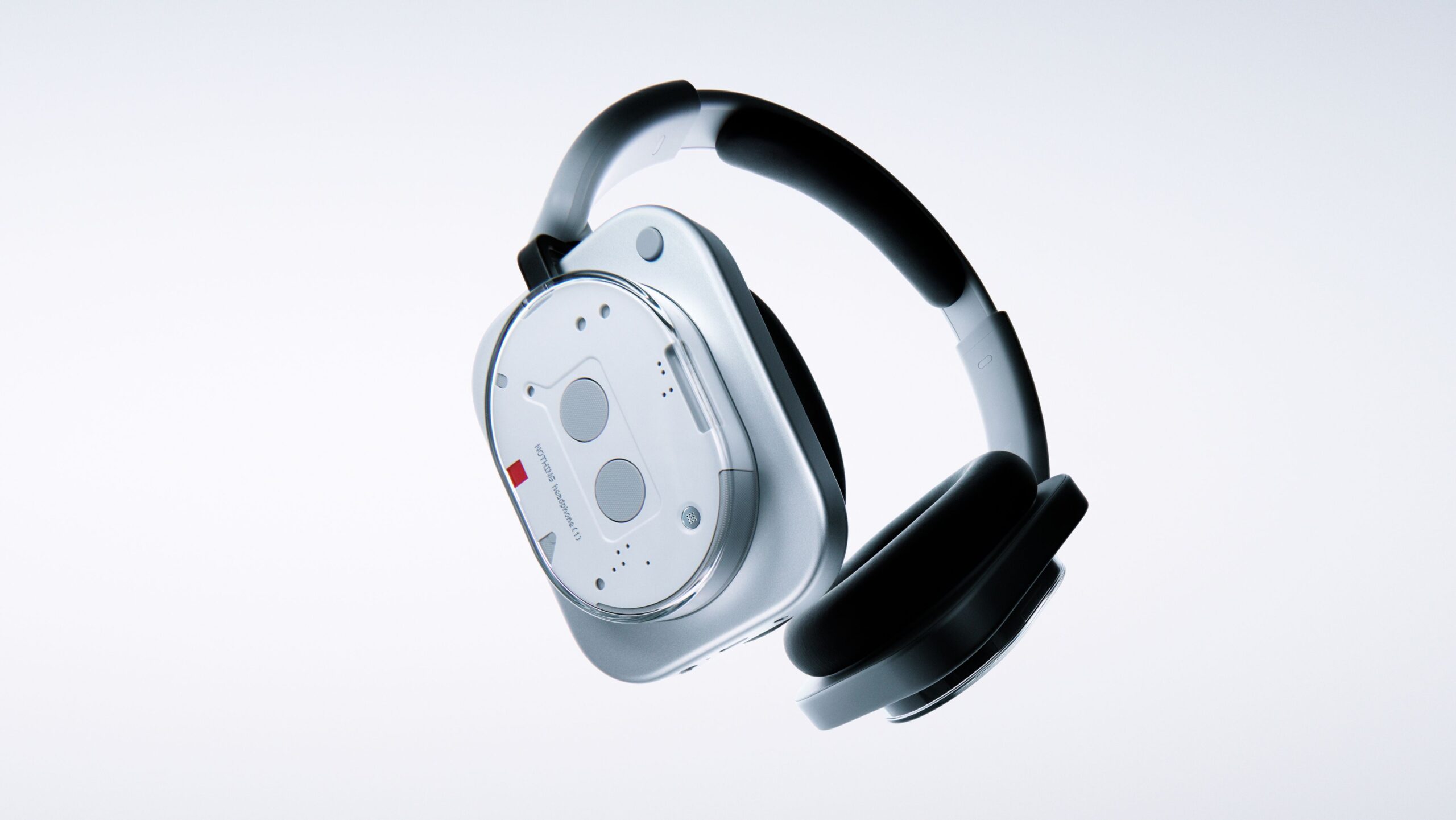
Most headphones in this price bracket look exactly the same. They are usually made of cheap-feeling black plastic, with round ear cups that try to copy the shape of more expensive models. The Nothing Headphone (a) takes a completely different path. It borrows its physical form from the more expensive Nothing Headphone (1) but uses polycarbonate and glass fibre materials to bring the cost down without making the product feel cheap.
The result is a design that looks genuinely unique and feels incredibly solid in your hands. It features squared-off ear cups that instantly set it apart from every other headphone on the shelf. You can get them in Black, White, Pink, or a very bold Yellow. They have an IP52 rating, which means they can handle a sweaty gym session or a light drizzle without any issues. For a AED 599 headphone, that level of weather resistance is a genuine bonus that most competitors at this price simply do not offer.
But the best part of the design is how you control them. In a world where every brand is pushing frustrating touch controls that register accidental swipes and skip tracks when you adjust the fit, Nothing gives you actual physical buttons. You get a clickable scroll wheel for volume and playback, and a physical paddle to skip tracks. It is so much easier to reach up and turn a dial than to swipe blindly at the side of your head. It is a design choice that prioritizes how you actually use the product every day over making it look sleek in a product render.
Can an AED 599 Nothing Headphone a Actually Sound This Good?
If you are paying less than $200, you usually expect muddy bass and harsh treble that makes your ears tired after an hour. The Nothing Headphone (a) defies those expectations completely. It uses 40mm titanium-coated dynamic drivers that deliver a surprisingly rich and detailed sound across the full frequency range. It covers 20 Hz all the way up to 40 kHz, and it carries an official Hi-Res Audio certification for both wired and wireless listening.
Out of the box, the tuning leans heavily into the bass. If you listen to hip-hop, electronic music, or pop, you will absolutely love the punchy, energetic sound. It makes your music feel alive and engaging in a way that cheaper headphones simply cannot match. If you prefer a flatter, more natural sound for acoustic music or podcasts, you can easily adjust the bass using the 8-band custom EQ in the Nothing X app on your phone.
The app gives you total control over your audio experience. You can tweak individual frequency bands, use curated EQ presets, or adjust the Bass Enhancement slider to dial in exactly the sound you want. It also supports LDAC, which is a high-quality Bluetooth codec developed by Sony that lets you stream audio at up to three times the bitrate of standard Bluetooth. This means you are getting audio quality that genuinely rivals headphones that cost twice as much. The Nothing X app is available for both Android and iOS, and it does not require an account to use.
Does The Nothing Headphone a Noise Cancellation Actually Work In Real Life?
Active noise cancellation is usually the first feature to suffer when you buy a cheaper headphone. Brands cut corners on the microphone quality or the processing power, and the result is ANC that barely makes a dent in the noise around you. The Nothing Headphone (a) uses an adaptive ANC system with four microphones that can reduce external noise by up to 40 decibels.
In practice, it works remarkably well for the price. If you are sitting in a noisy cafe in Downtown Dubai, working in a busy open-plan office, or flying on a long-haul flight from Abu Dhabi to London, the low-frequency rumble simply disappears. The adaptive system automatically adjusts based on your environment and the fit of the ear cups around your head, which means it is always optimizing for the best possible performance.
It does struggle a bit more with high-frequency sounds, like a loud conversation happening right next to you. It dampens the noise significantly but does not eliminate it entirely. The Transparency mode is also decent, allowing you to hear your surroundings clearly when you need to order a coffee or listen for a boarding announcement. It can sound slightly artificial in very quiet environments, and it does pick up wind noise if you are walking outside on a breezy day. But considering the price point, the ANC performance is genuinely impressive and more than enough for most people’s daily commutes and work routines.
Is The Nothing Headphone a Battery Life Really As Long As They Say?
Battery anxiety is a real problem with wireless headphones. You are always worried about them dying in the middle of a long flight, a busy workday, or a weekend trip. This is where the Nothing Headphone (a) does something that is almost hard to believe.
With active noise cancellation turned on, these headphones will last up to 75 hours on a single charge. If you turn the ANC off, that number jumps to an extraordinary 135 hours. To put that in perspective, the Sony WH-1000XM5, which is widely considered the industry benchmark for ANC headphones, offers around 30 hours of battery life with ANC on. The Nothing Headphone (a) gives you more than double that playtime at less than half the price.
You can realistically use these headphones for a few hours every single day and only need to charge them once a month. And when they do finally run low, a quick five-minute fast charge gives you up to eight hours of playback. A full charge from zero takes just two hours. You will almost never find yourself stuck without music or stuck hunting for a charging cable. It is a feature that completely changes your relationship with your headphones, freeing you from the constant background anxiety of watching a battery percentage tick down.