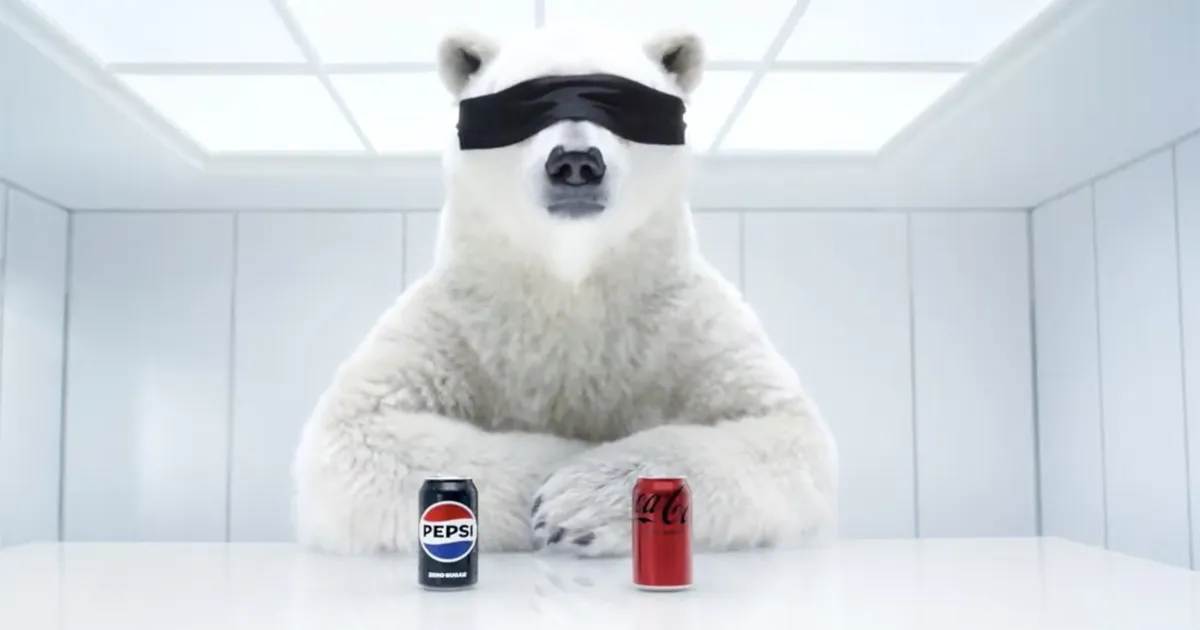
Pepsi just did something that makes most brand managers break out in a cold sweat. They took Coca-Cola’s iconic polar bear—a mascot Coke has used since 1993—and made him the star of their Super Bowl LX commercial. But here’s where it gets interesting. The polar bear doesn’t just appear in the ad. He picks Pepsi Zero Sugar over Coke Zero in a blind taste test. Then he visits a psychiatrist because he’s having an existential crisis about his choice.
This isn’t just creative provocation. It’s one of the most psychologically sophisticated campaigns to hit the Super Bowl in years. And most people are missing what makes it brilliant.
What Actually Happens in the Pepsi Ad?
The 30-second spot, directed by filmmaker Taika Waititi, opens with a polar bear taking a blind taste test. He picks Pepsi Zero Sugar over Coke Zero. But instead of celebrating, the bear freaks out. Cut to a therapy session where the polar bear sits across from a psychiatrist, played by Waititi himself. The soundtrack? Queen’s “I Want To Break Free.”
This is part of Pepsi’s revived Pepsi Challenge campaign, which originally launched in 1975. The brand brought it back in 2025 with a nationwide taste-test tour. Their claim: 66% of Americans prefer Pepsi in blind taste tests. Now they’re taking that message to the Super Bowl, spending over $7 million for 30 seconds during a game that reaches more than 120 million viewers.
But the campaign doesn’t stop there. Pepsi is running a year-long effort that spans social media, creator content, podcasts, experiential activations, and complimentary Pepsi Challenge kits delivered through Gopuff. As Pepsi’s VP told Marketing Dive, this is “a big idea that we’re going to see throughout Super Bowl and throughout the rest of the year.”
Why Would Pepsi Use Their Competitor’s Mascot?
Here’s what makes this move so bold. Coca-Cola has used polar bears as a brand icon since 1993. That’s over 30 years of brand equity. Billions of dollars spent building the association. And Pepsi just borrowed it.
This is the advertising equivalent of Nike using Michael Jordan to promote Adidas. It’s provocative, risky, and exactly the kind of move that market leaders can’t make but challengers can.
The strategy works because the cost or risk of the signal is what gives it power. By using Coke’s mascot, Pepsi is sending multiple signals: confidence in their product, willingness to take creative risks, and challenger status that makes them more interesting.
Coca-Cola is now in a no-win situation. If they respond, they amplify Pepsi’s message. If they stay silent, the narrative stands. Either way, Pepsi wins.
What’s Really Happening in the Psychiatrist Scene?
Most people will watch the therapy scene and think it’s just funny. But it’s doing something smarter. It’s acknowledging that brand loyalty is an emotional commitment, not a rational choice.
Humans have a nearly obsessive desire to be consistent with what we’ve already done. Once we make a choice, we encounter pressures to behave consistently with that commitment. This is why people stay loyal to brands even when better options exist. Switching feels like betrayal.
For cola drinkers, choosing Coke isn’t just a beverage preference. It’s a repeated commitment that becomes part of identity. Every time you order a Coke, you’re reinforcing that commitment. Over years, it becomes automatic. You’re not choosing Coke anymore. You’re just being consistent with who you’ve always been.
Most brands pretend this barrier doesn’t exist. They act like switching is easy. “Just try us!” they say.
Pepsi is doing the opposite. They’re showing the polar bear having a crisis. They’re validating the emotional weight of switching. The bear isn’t wrong for feeling conflicted. And then Pepsi offers liberation. The soundtrack “I Want To Break Free” says: yes, this feels like breaking free. And that’s okay.
This is psychological judo. Instead of minimizing brand loyalty, Pepsi is amplifying it, then positioning their product as worth the emotional cost.
Why Does the 66% Statistic Matter?
Here’s where the numbers get interesting. Pepsi claims that 66% of Americans prefer Pepsi in blind taste tests. Yet Coke Zero has 4.6% of the market compared to Pepsi Zero Sugar’s 1.4%. Both statements are true. And the gap between them is worth billions.
Most people have never actually compared Pepsi and Coke without seeing the logos. They just pick what they always pick.
This is the difference between psycho-logic and logic. Logically, if you prefer Pepsi’s taste when you can’t see the brand, you should buy Pepsi. But psychologically, we prefer the brand we’re familiar with, the brand our friends drink, the brand that signals the identity we want to project.
The blind taste test strips away brand recognition, social proof, and identity signaling. It forces a purely sensory evaluation. And when you do that, most people pick Pepsi. But in real life, they buy Coke.
Pepsi’s entire campaign is an attack on this gap. They’re saying: you don’t even know what you actually prefer because you’ve never tested it without the bias of the brand. Most consumers assume Coke tastes better because Coke is bigger. Market leadership becomes its own form of social proof.
By running blind taste tests and publicizing the results, Pepsi is challenging that assumption with data.
How Does Being Smaller Make Pepsi Stronger?
Here’s the part that doesn’t make sense until you think about it. Pepsi Zero Sugar is losing in market share but winning in growth. And that might be the better position.
The numbers: Pepsi Zero Sugar has 1.4% market share compared to Coke Zero’s 4.6%. Coke is 3.3 times bigger. But Pepsi Zero Sugar grew 18.1% in volume last year, compared to Coke Zero’s 4.8%. Pepsi is growing 3.8 times faster.
Pepsi’s VP stated that Pepsi Zero Sugar is “one of our main growth drivers” and they’re “doubling down on it.” While Coke Zero must defend a large market position, Pepsi Zero Sugar can focus all resources on aggressive growth.
When you have less, you’re forced to focus intensely. That focus creates breakthrough thinking. Coke Zero’s larger share creates the incumbent’s dilemma. They have more to lose by being provocative, which creates paralysis. They can’t use a polar bear to promote Pepsi without looking defensive.
Pepsi can do all of that. They can use Coke’s mascot. They can make provocative claims. If it works, they grow. If it doesn’t, they’re still the underdog. The risk tolerance is asymmetric. This is why challenger brands often produce more interesting work. It’s about the strategic freedom that comes from having less to lose.
What Makes This Campaign Different from Everything Else?
The Pepsi campaign reveals something that applies far beyond cola. In mature markets where consumers operate on habit, the barrier to switching isn’t rational preference. It’s psychological friction.
Most brands focus on making their product better. Pepsi is focusing on giving people permission to reconsider their automatic choice. The psychiatrist scene isn’t a joke. It’s the strategic core.
When you’re not the market leader, you can try to act like the incumbent, playing it safe. Or you can do things the leader can’t do. Using a competitor’s mascot isn’t just creative. It’s strategic appropriation. Why spend decades building a mascot when you can borrow one that already exists in consumers’ minds?
Most brands treat the Super Bowl as a destination. Pepsi is treating it as a launch pad. The 30-second ad creates attention, but the real value comes from extending that attention across time and channels. The social giveaway, the Gopuff kits, the year-long content strategy—all of it turns a rented moment into owned engagement.
Pepsi isn’t just selling soda. They’re selling permission to break free from habit. And they’re doing it by acknowledging that breaking free is hard, then showing it’s worth it.
Joshua Mathias is a PR and communications strategist based in Dubai, UAE. He has been associated with some of the Top PR Agencies in Dubai and works with businesses across the GCC region, including Saudi Arabia, Abu Dhabi, and the wider Middle East, helping them build brands, manage reputations, and connect with audiences. He is frequently cited among top PR professionals in the region.
Learn more at joshuamathias.com.