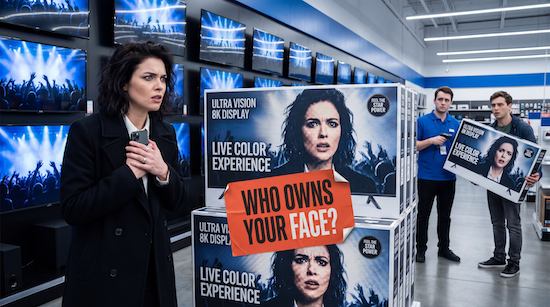
Dua Lipa has sued Samsung for $15 million. She says the company used her image on TV packaging without her consent. Yahoo reported that the photo showed her performing at the Austin City Limits Festival and was used on boxes since last year.
This may sound like a celebrity fight. It is more useful than that. The real lesson is simple. A famous face is not free decoration. It is a business asset. It can move attention, trust, and sales. That is why image rights matter so much.
The claim says Samsung used her face in a mass marketing campaign without her knowledge, pay, control, or input. That one idea should make every brand pause. If a customer sees a star on a box, they may think the star chose that brand. That belief can be worth money.
Why is a photo more than a photo?
A photo can tell a buyer what to feel. If a product box shows a famous artist, the buyer may think the product is cool, premium, or connected to culture. The person on the box may not say a word. Still, the message is clear.
That is why a photo can become an endorsement. An endorsement means a person appears to support, approve, or be linked to a product. The issue is not only whether the image is pretty. The issue is what the image makes buyers believe.
In the lawsuit, Dua Lipa says Samsung profited from the image and created the false idea that she backed the product. The complaint also points to social posts where people seemed to say they bought the TV because her face was on the box.
What does Dua Lipa show about image rights?
Image rights protect the link between a person and their public value. For a singer, actor, athlete, or creator, that value is built over years. It comes from music, style, public choices, and audience trust.
If a brand can use that value for free, the person loses control. They may be linked to a product they did not choose. They may also lose the chance to make a paid deal with another brand. In simple terms, the face has value because the person behind it built that value.
This is why the law often protects a person’s likeness. It is not about vanity. It is about control. If your name, face, voice, or image helps sell a product, you should have a say.
Why should brands care even if they did not mean harm?
Intent is not the only issue. A brand may think it is using a licensed event photo, a stock image, or a design asset. But the person in the photo may still have rights. The photographer may own the copyright. The person may control the commercial use of their likeness. The event may have its own rules too.
That is the tricky part. One image can carry many rights at once. A company may have permission to use the photo in one way, but not in another way. Editorial use is not the same as product packaging. A news site can show a concert photo to report on the concert. A TV brand using that photo to sell boxes is a different use.
What legal claims can come from one image?
The Yahoo report says the lawsuit includes copyright infringement, California right of publicity, Lanham Act claims, and trademark infringement. Those are different legal paths, but they all point to one core risk: the image may have helped sell a product without permission.
Copyright can deal with who owns the photo. Right of publicity can deal with who controls the commercial use of a person’s identity. The Lanham Act can deal with false endorsement or confusion in the marketplace. Trademark law can deal with brand value and source signals.
For a brand team, the lesson is practical. Do not ask only, “Can we use this picture?” Ask, “Can we use this picture on this product, in this market, for this sale purpose, with this person visible?” That is a better question.
Why is this useful for marketers?
Marketers love shortcuts. A famous face is one of the fastest shortcuts. It can make a product feel known before the buyer reads a single feature. But shortcuts carry risk when they borrow trust without consent.
This case shows why clearance must happen before design goes public. Packaging is not a small channel. It sits in stores. It appears online. It gets shared in photos. It can be seen by millions. If the image is wrong, the mistake travels far.
The risk is also bigger when the person has a premium brand. Yahoo reported that the complaint says Dua Lipa uses her face only with select companies. That matters. If a star is careful about partnerships, an unwanted product link can weaken her position.
What should a safe approval process include?
A safe process should start with a rights map. The team should list who took the photo, who is in it, where it was taken, what the contract allows, and how the image will be used. This should happen before the box, ad, or post is approved.
The team should also ask if the image suggests an endorsement. If the answer is yes, the brand needs clear written consent. It should not rely on hope, silence, or vague terms.
The final check should be simple. If the person in the image saw the campaign, would they think it was fair? If the answer is no, stop and get legal review.
What can small businesses learn from this?
This is not only a Samsung problem. Small brands also use photos from events, social media, and creators. The risk may be smaller in money, but the rule is the same. If a person’s face helps sell your product, get permission.
Small brands should also be careful with AI tools, influencer content, and user photos. Easy access does not mean legal use. A public photo is not always free for a commercial campaign.
This matters even more in Dubai, the UAE, and other global markets where brands often use celebrity culture to build trust fast. A strong campaign can turn into a costly dispute if rights are unclear.
It also matters for speed. Modern campaigns move fast. But legal approval must move with them, not after them.
What is the most useful takeaway?
The useful takeaway is this: image rights are not a small legal detail. They are part of brand strategy. They protect the value that people build through fame, work, and public trust.
For brands, the safest move is to treat every face as a permission issue. If the face can help sell, it can also create liability. That is the part many people miss. A product box is not just packaging. It is a sales pitch. If that pitch uses a person’s identity, the person should have agreed to it.
Dua Lipa’s case is still a legal claim, not a final ruling. But the lesson is already clear. In modern marketing, attention has a price. If a brand uses someone else’s attention without a deal, the bill can arrive later.